Observations on the heavenly-earthy Pacific Northwest and life in vivid, quirky Seattle.

Tuesday, April 03, 2007

This Day

This is a day when, sitting on a driftwood log on the beach, heels dug in the rocks or crouched in the garden clearing away the winter weeds, the sun warms your back and the heat sinks deep into your bones. The body responds… a sensuous relaxation, a gratitude and quiet happiness.

Gold is coming back to the sun… no longer that sheer, winter white. Even its color is warming. And what, only two weeks ago, was a fragile lace of green in the trees is now growing lush and luscious. Still fresh and clean… not the worn, dusty olive of August.

These waxing days, like a cat uncurling on a porch banister, are slowly, languidly stretching longer. Cold, dark memories of December continue to dwindle, retreating from the light.

Labels: , ,

Tuesday, January 16, 2007

The Mountain has Left the Building

What a difference a day (or two) makes.
What a difference the weather makes.

It is astounding how a change in weather here transforms our world. Sunday was a palatte of oversaturated colors in sharp focus and infinite. Today everything is soft and grey and insulated.

Labels: ,

Friday, January 12, 2007

"Solar Power"

Every Cascadian, when emerging from his or her home today, peeked up to the sky then danced gleefully in the street. The sun is out again, making it two days in a row of blue sky. Moreover… sun is forecast for the entire next week. Hallelujah. We haven’t had a week of sun for months. Literally.

Left: Early morning blue sky over Bellevue and the Cascade Mts.

In terms of light, this is a tough time in the Pacific Northwest. The sun rises late and sets early. Thick cloud cover is the sky-du-jour just about every “jour” of the winter season. Magnifying the deprivation is that most folks arrive to their offices before sunrise and leave them after sun set. We end up a city of moles, squinting into the glare of the occasional sunny day, sunglasses long misplaced in the weeks of dreary grey. It’s a bit of a shock to the system, albeit a welcome one.

Many folks up here feel the effects of this. SAD (Seasonal Affective Disorder) sets in with a mild case of the blues, lethargy and a general desire to hibernate. Many of us take a sun trip sometime between January and early March to off set this. It doesn’t have to be warm (although that is the ultimate winter escape). A ski trip to Idaho or Utah can off set the withdrawal. All those sun rays reflecting off all that snow. Some of us get full spectrum light boxes or sunrise alarm clocks Some of us just tough it out.

In the glory days of July and August, when the days are long, warm and lushly green it’s easy to forget this time of year and to remember why we stay. Last week we dared not dream of the sun, it seemed so remote. Today we revel in it.

Labels: , ,

Monday, December 18, 2006

Campfire Girl

Well, here we are on day four after the big, Seattle windstorm and parts of the city, including my neighborhood, are still without power. It has been an inconvenience, but not a hardship. My husband and I are fortunate to have a fireplace and a gas-powered water heater. Although there have been invitations from friends to stay with them in heated and lit homes with operative stoves, refrigerators, stereos and DVD players, we have declined. We keep believing that it just CAN’T go on much more than a few hours. We live in the city, for heaven’s sake. But… what do we know? (There are also the pets to consider, and the cat does not cotton to slumber parties away from home.)

Nonetheless, we keep waking up to yet another cold morning. And with flashbacks to episodes of “Little House on the Prairie,” we stoke the fire, pop an enameled coffee pot in the flames, and make our morning coffee by hand. It’s amazing how much energy it takes to keep a room warm with a fireplace in cold weather: gathering and hauling wood, setting/starting the fire, keeping it stoked, gathering and hauling more wood. In some ways the cold temperatures that followed the storm (below freezing at night and not above 40 during the day) are a blessing as all our food is in coolers outside. A lot would have been wasted otherwise. However, keeping ourselves and the animals above freezing has been a continuous task in the mornings and evenings.

Performing this daily ritual has me thinking back to my days as a Campfire Girl. Growing up in Cascadia at the time I did, Campfire seemed a much more relevant girls’ club than Girl Scouts. Campfire was largely focused on outdoor and survival skills. Being outside and in nature as much as I was as a kid, it was truly useful to understand how to use a compass and read a map, to identify plants (what to not touch or nibble), what to pack even if you were going out for a little day hike (whistle, 1st aid kit, jackknife, extra food and water, matches, etc), and how to build a fire, particularly in wet and cold conditions. Terms such as “tinder” and “kindling” have come floating back, as have recollections of how to set a fire the right way so it will start easily without over-fueling it (which is wasteful as well as potentially dangerous in the woods), and how to improvise a cook stove over and around the flames.

Granted, given that I AM a city-girl now and that most of Seattle is back on the grid, we have used our outage as a likely excuse to dine out each night. Another bright-shiny silver lining to our predicament. I am hoping, however, that we won’t be out again tonight. And, with all due respect to my old camp counselors and Laura Ingalls-Wilder, we won’t forgo dining out to bake chicken in tin foil in the embers. I would like my lights back please. I prefer my camping in small doses.

Labels: , ,

Thursday, December 14, 2006

On Wind and Community

Another storm will be sweeping into Puget Sound and the Seattle area tonight. Officials are exhorting us to have three days worth of ready-to-eat food and battery-powered lights and radio as we will have winds up to 60 miles per hour (90 in some areas) along with another deep soaking of rain. Electricity, phone and other line-based services will likely be taken out by falling trees. That is, the trees that have not already fallen from winds earlier this week.

Left: Looking toward Bellevue. The calm before the storm.

The wind and rain combination is a dangerous one, particularly in the Northwest where up to 100' foot tall Douglas Firs dominate the landscape. Pacific Douglas Fir trees have very shallow root systems. When rain soaks the ground it softens, making it easier for a tree to topple. Ironically, but logically, it is the largest that are at greatest risk of being uprooted.

In the forests this is not such a problem, of course, as it is simply part of the ecology cycle. It is also less likely to happen in a forest, as the trees absorb the force of the wind as a large group. The bulk and root systems intertwine, acting as buffers and reinforcement. In the city and suburbs, these giants are often standing solo or in small clumps, making them far more vulnerable to the elements.

The vulnerability that comes with isolation stands true for our human community as well, particularly at times like this. Caring for and about our neighbors, in both the specific and general sense, uplifts and provides a greater quality of life for everyone, including ourselves. We create connectedness and relationships. The act of reaching out makes others feel not only safer but more willing to reach out themselves. And, in the act of service, we serve ourselves by exercising our integrity, our generosity, our humanity. We become better people simply from the satisfying act of helping.

Labels: , , ,

Tuesday, November 28, 2006

When it snows in Seattle

Snow in Seattle, and most of the lowlands of Cascadia, is rare. We get approximately 3 non-consecutive days of snow a year. Usually it snows at night with the first bit melting, and a layer of snow covering a film of ice. By evening time the next day, the weather has warmed and the snow has melted. The marine air and proximity to such large bodies of water keep the temperatures temperate here.

As a result, when it does snow it is an event. It is a meteorological event, a community event, a news event, a personal event. Seattle pretty much shuts down in the snow. Part of it is because snow is so rare. We are unprepared, as a city and as individuals. Why invest heavily in snow equipment when it's such a small part of our lives? We never really learn how to drive in it in the city, as we get no practice. There is also the progression of a snow event itself, with the melting and refreezing comes ice. Then there is the geographical reason. We live on a city of hills. Trying to get to work becomes a carnival bumper car ride with less control.

(Above: Looking Southeast from Madrona Park across Lake Washington to Mt. Rainier)

So, we have a tendency to just give in to the weather at these times. It is self-serving as well because we become kids in the snow. Go for a walk and everyone is smiling. Seattle is so pretty in the snow, and it's a holiday. Everyone is walking or riding the bus, happily jostling to let just one more person on as, "we are all in it together." We use it as an excuse for cooking big, comfort-food meals and making hot, spiced cider and wine or walking to a neighborhood pub to share stories with neighbors.

Visitors be forewarned, the city shuts down in random fashion. Stores and museums may be closed. Buses may take alternate routes. Driving can be treacherous. And with the microclimates and convergence zones here, one neighborhood may have only a trace of snow, while the next on over may have 6". My recommendation is go with the flow and live in the moment. Soak in the childlikeness of the city on days like this.

(Above: Looking North along the shore of Madrona Park)

The city parks are the place to be. Seattlites gather in city parks and make communities of snowmen, let their kids and dogs race around, and take pictures.

Labels: , ,

Wednesday, November 22, 2006

Evergreen

The recent storms in Seattle have stripped fall from the trees. What bright yellow and red leaves there were left now lay in soggy piles over storm drains, blocking the rain water which "piles up" in turn, creating small lakes along the side of and into the roads. The loss of the color makes the days feel even more dreary.

What I tend to forget is how much color -- green -- is left. The majority of trees in Cascadia are evergreen. No matter the time of year, the landscape never looks stripped. It is dark color, but color all the same. When I appreciate this most is when I am seperated from it... when I am in an alternate winter landscape of bare deciduous trees, lacy forests of brown-grey branches holding up the monochrome sky.

Even the undergrowth stays green in the Northwest, with the sword ferns and rhodedenderons and moss. It is more spare, but it is not bleak. And rarely is there snow in the lowlands. This time of year we bring it inside as well... cedar and fir bows, swags of holly, laurel, and pine. We are surrounded by green, that lovely, dark, winter green.

Labels: , ,

Wednesday, November 15, 2006

Quality of Light

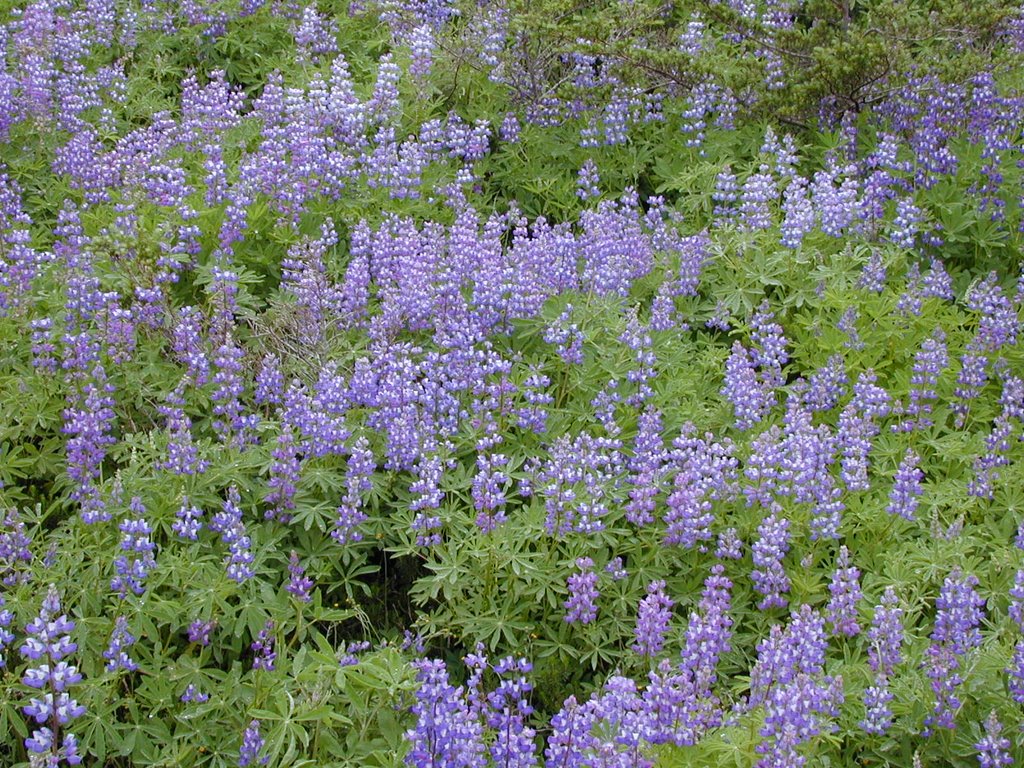
In my last post, I mentioned the water-laden air here. Light in Cascadia is heavily affected by this. There is often an iridescent or opalescent quality to the light, particularly on sunny days from fall equinox to spring, when the sun is lower on the horizon. Sunlight shines through the moist air, adding a soft quality and depth to the landscape. The moisture that coats the trees, basalt rock, ferns, everything, deepens their colors as well. The result is visually transfixing. The environment seems to glow. Colors are oversaturated. Capturing this phenomenon has long been the obsession of Northwest artists. (The book, “Iridescent Light,” which tracks the evolution of modern Northwest art through its artists, describes this well.)


(Left: Lupin on Mt. Baker)

Bodies of water in the landscape, large and small, affect the light and the environment’s color palette as well. When the sun appears, the glare off the Sound, the ocean, the lakes, and even the puddles can be blinding. Yet, late in the day when the low sun cuts across the landscape under a bank of heavy clouds, the effect is stunning… like a movie set.

Then, on days like this the steely sky is reflected by the water, and both turn grey. Everything is shrouded in muted tones. Color withdrawal sets in….

Labels: , , ,

Sunday, November 12, 2006

The Element and Force of Water

Water defines Cascadia. Rain, rivers and lakes sculpt and feed the landscape. Puget Sound and the Pacific Ocean are our west wall. Salmon, traveling from mountain streams to the sea and back again has sustained human culture here for eons and remains an icon in NW culture. Cascadia, by one definition, is delineated by the rivers that empty into the Pacific.
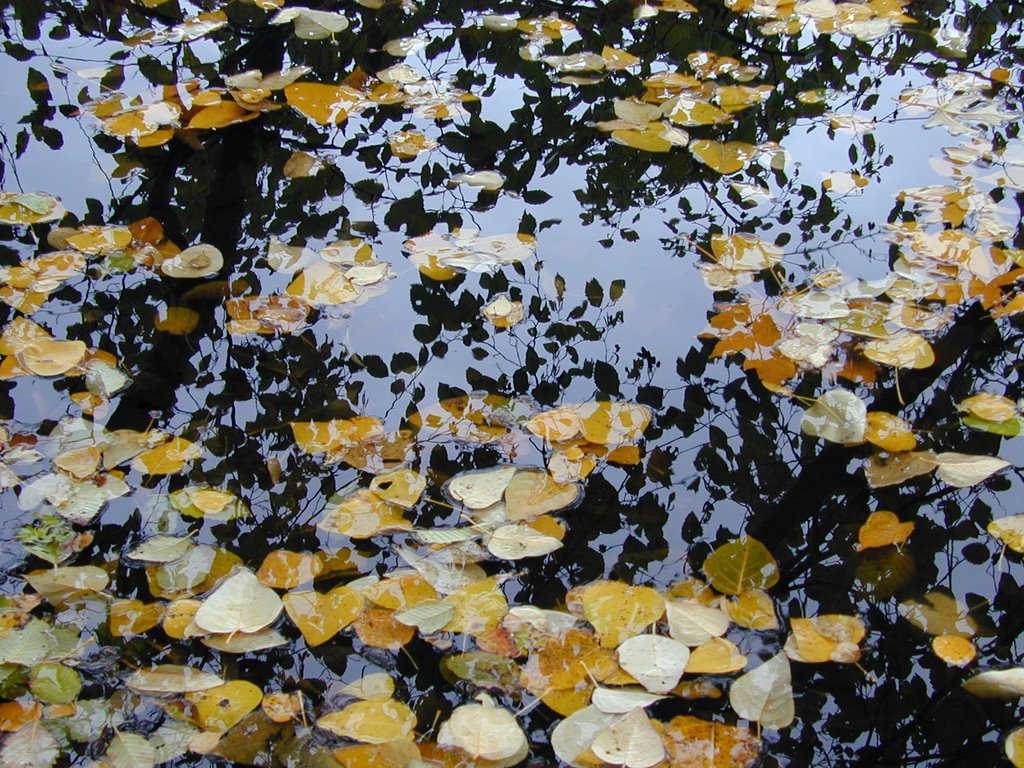
We live in a temperate rain forest. The trees and undergrowth of the forests are as lush as many in the tropics, and stay equally green year around.

(Left: A rainy November Sunday afternoon in the Seattle Arboretum.)

Cascadia is renown (or infamous) for its grey skies and puddles. We have almost as many terms to describe rain as the Inuits have for describing snow: spitting rain, mist, sprinkles, showers (and its variations such as stattered and thunder), downpours, soaking rain, blowing rain, etc.

This reputation is well earned eight months out of the year, from November through June. The rain and water not only mold our geography but our style and culture as well. Fishing is a major industry here. Part of the Washington State highway system is a fleet of ferries that carry commuters across Puget Sound. Water sports, from fishing to boating, to skiing and swimming are hugely popular. Opening Day is a big Seattle event. Even the Northwest style of contemporary art is based, in part, on the study and expression of the quality of moisture-laden light in this region.

The soft grey color palate, low clouds, and the sound of the rain insulate winter days. In contrast to the frenzied outdoor culture of summer and early fall, days in winter and early spring are spent in libraries and bookstores, cinemas and theaters, coffee houses , museums and other gathering places... that is if you are not off skiing, boarding, or snowshoeing in the mountains, or out eagle-watching or winter sea kayaking or surfing (crazy loons!).

Like all natural forces, the rain and the tides are humbling as well. Winter storms and high tides wash away salt-water-front homes and heavy rains (like the recent ones) wash away river-side homes and lowland farms.

Water colors and channels life in Cascadia. It is one of the forces that shape the culture. We are fortunate for it, although on gloomy days like today, with weeks of rain in the past and more to come, its easy to forget.

Labels: ,


Web cascadiasong.blogspot.com
seattlesong.blogspot.com
Travel Blogs - Blog Top Sites
A Note Regarding Links: A few of the links from this site are to sites that sell products or services. Please note that, although I may receive a small compensation for the link, I only link to these sights when I genuinely like/recommend them. Also know that these third parties may serve content and/or advertisements and collect information directly from visitors and may place or recognize cookies on visitors' browsers.